What is a DC motor drive controller? A DC motor drive controller is the power-electronics interface between a fixed AC or DC supply and a brushed, shunt-wound, or permanent-magnet DC motor. It converts that fixed source into a regulated, variable DC output — governing armature voltage, current, speed, torque, and direction — and adds the closed-loop regulation, protection, and tuning features that real-world industrial motor control demands. Without a drive, a DC motor runs at a single fixed speed determined by supply voltage and load; with the right DC motor drive controller, that same motor becomes a precision speed and torque actuator across its full operating envelope, from creep speed up to base speed and into the field-weakening range.
At a system level, every DC motor drive controller performs three jobs at once. First, it converts power: rectifying AC to controlled DC with thyristors, or chopping a DC bus with MOSFETs/IGBTs at 10–30 kHz. Second, it regulates: an inner current loop limits armature current to protect the motor and silicon, while an outer voltage or speed loop holds the setpoint as load changes. Third, it protects and integrates: overcurrent, overvoltage, undervoltage, field-loss, tach-loss, and thermal trips — plus isolated 0–10 V, 4–20 mA, potentiometer, or serial inputs so the drive sits cleanly inside a PLC- or HMI-driven machine. This combination is what separates a true DC motor drive controller from a simple variac or rheostat speed adjustment.
DC motor speed control in industry is dominated by two power topologies — and a third for energy-recovery duty. PWM DC motor controllers switch a DC bus on and off at high frequency using MOSFETs or IGBTs, which makes them the natural fit for 12–90 V brushed and PMDC motors fed from batteries, solar, or low-voltage DC supplies. SCR DC motor drives use phase-controlled thyristors to rectify 115/230 VAC mains directly into a controlled DC armature voltage, which is exactly what 90 V and 180 V industrial DC motors expect. When the load can overhaul the motor — hoists, downhill conveyors, centrifuges, web tensioners, large flywheels — a four-quadrant regenerative DC drive is required so braking energy is returned to the AC line instead of dumped into a resistor bank.
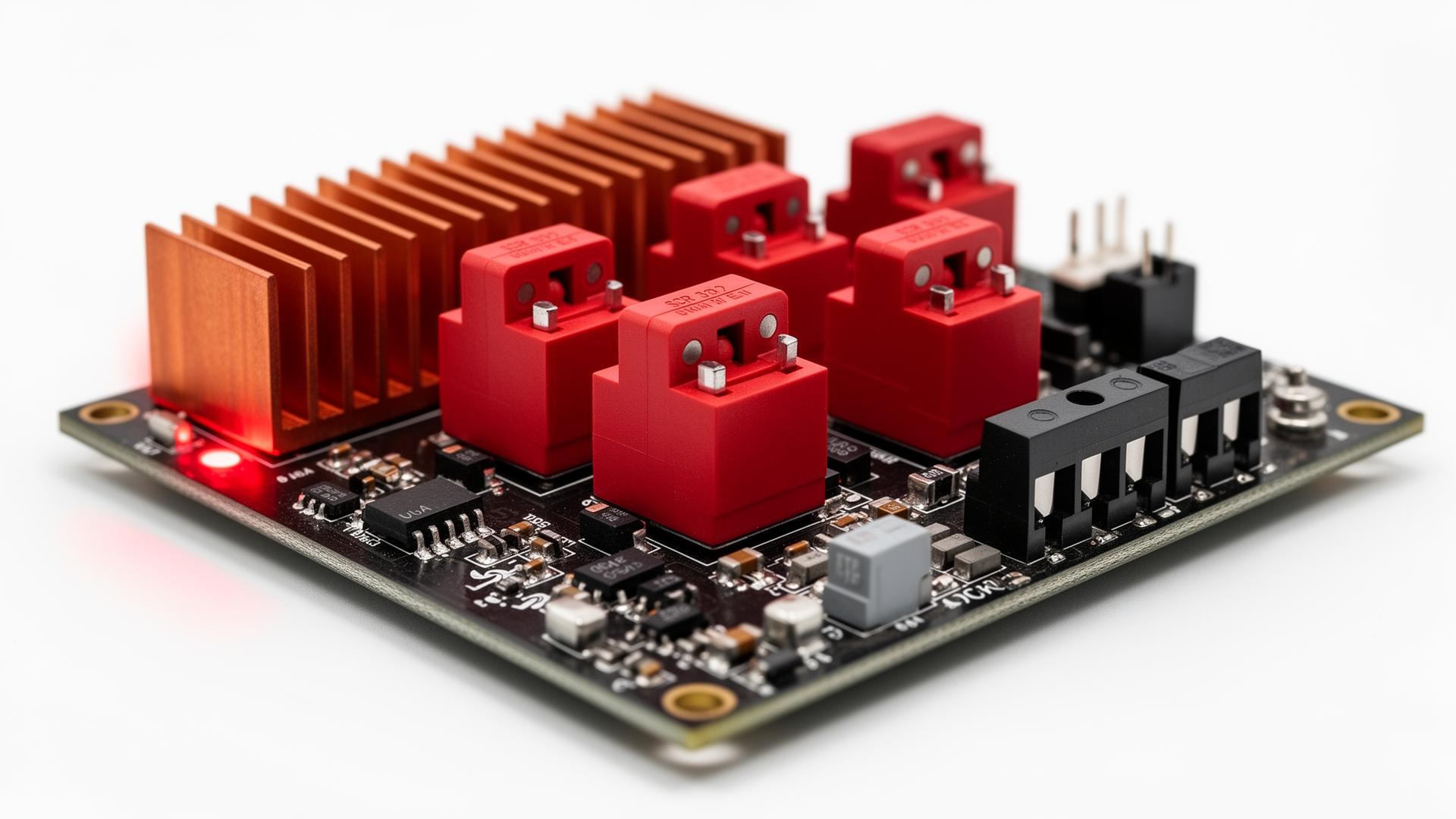
Ameronics manufactures all three families in-house. Our SCR DC motor drives — RedVolt, Voltix, Regencore 4Q, and Revoxa 4Q — cover non-regenerative through full four-quadrant regenerative DC drive duty for 90/180 VDC industrial motors from fractional HP up to 3 HP, and they are the workhorses behind countless retrofits of legacy Reliance, GE, and Boston Gear panels. Our PWM DC motor controllers — FlexVolt and Pulseguard — handle 12–24 V DC motors at up to 60 A in mobile equipment, AGVs, packaging machinery, and battery-powered automation. Building all three topologies under one roof means we can match the drive to the supply, the motor, and the duty cycle without forcing the application into whatever single product line a competitor happens to sell.
Choosing the right DC motor drive controller for industrial motor control comes down to three questions. What is the motor voltage and supply? Does the load ever overhaul the motor? And how precisely does the speed need to be regulated? For 12–90 V brushed and PMDC motors fed from batteries or low-voltage DC buses, a PWM DC motor controller delivers the smoothest current waveform and the highest efficiency. For 90 V or 180 V industrial DC motors fed from 115/230 VAC mains, an SCR DC motor drive is the proven, rugged answer from fractional horsepower up to several hundred HP. Whenever the load can drive the motor or fast, controlled deceleration matters, a four-quadrant regenerative DC drive is the correct specification — and Ameronics will help you size it.
Every Ameronics DC motor drive controller is engineered for industrial reliability: current limit, IR compensation, adjustable acceleration and deceleration ramps, isolated control inputs, and tach or armature feedback for true closed-loop DC motor speed control. All units are designed, built, and supported in the USA, with full OEM lifecycle support, retrofit consultation for obsolete drives, and custom variants available for unusual voltage, current, enclosure, or communication requirements. If you are specifying industrial motor control for a new machine, retrofitting an aging line, or replacing a discontinued OEM drive, this page is the right starting point — the sections below break down each topology, when to use it, and where it fits.