Regenerative DC Drive

Regenerative DC Drives — Four-Quadrant SCR Control

Ameronics Regencore 4Q and Revoxa 4Q are four-quadrant regenerative DC drives that motor and brake the load in both directions, returning braking energy to the AC line. Engineered as industrial DC motor drive controllers for hoists, conveyors, mixers, and any overhauling-load application.

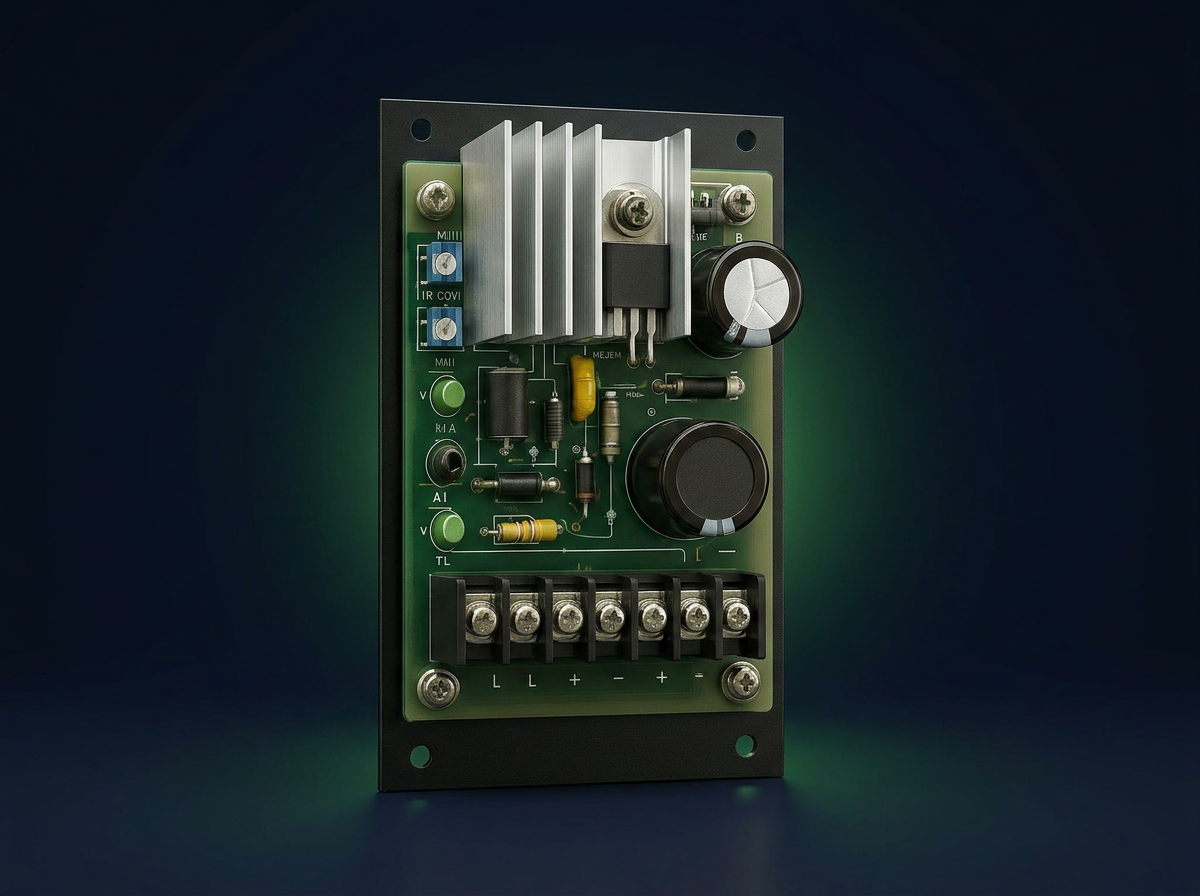
Ameronics Regencore four-quadrant regenerative SCR DC drive for industrial motors
Overview

Background & technical context

A regenerative DC drive operates in all four quadrants of the torque–speed plane: it can apply torque in the same direction as motion (motoring) or opposite to motion (braking), in either direction of rotation. This is achieved with a dual SCR bridge that can source or sink current from the motor armature, making it a true bidirectional DC motor drive controller.

How regenerative braking feeds energy back into the system: when the load tries to overhaul the motor, the armature back-EMF exceeds the drive's commanded voltage. The second anti-parallel SCR bridge fires at a phase angle greater than 90°, switching from rectifying to inverting mode. Current reverses through the armature and the drive pumps that current back through the AC mains transformer — the kinetic energy of the load becomes real electrical energy returned to the supply, instead of heat dissipated in a dynamic braking resistor.

4-quadrant operation in plain terms: Quadrant I — forward motoring (positive speed, positive torque). Quadrant II — forward braking (positive speed, negative torque, energy regenerated). Quadrant III — reverse motoring. Quadrant IV — reverse braking. A 4Q regenerative SCR drive transitions between all four states seamlessly, without contactors and without waiting for a braking resistor to cool.

Regenerative vs SCR DC motor drives: a standard SCR DC motor drive (also called a non-regen or 1Q/2Q drive) is the right tool for unidirectional, mostly-motoring loads such as pumps, fans, and extruders. A regenerative SCR drive adds a second thyristor bridge so it can both source and sink armature current, returning braking energy to the line. The trade-off is more silicon, more control complexity, and a higher price — paid back quickly on overhauling loads or high-duty braking. For low-voltage or fractional-horsepower duty, a PWM DC motor controller is usually a better fit than either SCR topology — compare all three families on the main DC motor drive controller page.

Ameronics offers two regenerative DC drives: Regencore 4Q on chassis and Revoxa 4Q enclosed. Both share the same proven SCR-based four-quadrant core, with tach or armature voltage feedback and isolated control inputs.
At a glance

Key highlights

  • Four-quadrant SCR topology
  • Energy returned to AC line
  • Bidirectional motoring + braking
  • Chassis (Regencore) or enclosed (Revoxa)
Capabilities & specs

Technical details

How four-quadrant works

A 4Q SCR drive uses two anti-parallel SCR bridges so that current can flow either direction through the motor armature, enabling motoring and braking in both directions of rotation without contactors.

  • Forward motor + forward brake
  • Reverse motor + reverse brake
  • No braking resistor required

Regenerative braking energy flow

When the load overhauls the motor, the second SCR bridge inverts at a firing angle above 90°, reversing armature current and pushing energy back through the supply transformer to the AC line.

  • Back-EMF > commanded voltage
  • Inverting-mode SCR bridge
  • Energy returned, not dissipated

Regenerative vs SCR (non-regen)

Non-regen SCR drives motor in one direction and dump braking energy as heat. Regenerative SCR drives motor and brake in both directions and recover that energy — at the cost of a second bridge.

  • Non-regen: 1Q/2Q, lower cost
  • Regen: full 4Q, line-side recovery
  • Choose by duty cycle, not horsepower

Regencore 4Q — chassis

Four-quadrant regenerative SCR DC drive on a chassis for OEM panel integration.

  • Chassis mount
  • Tach or armature feedback
  • Industrial reliability

Revoxa 4Q — enclosed

Same regenerative SCR core as Regencore in a NEMA-style enclosure for stand-alone deployment.

  • Enclosed 4Q regen
  • Field-ready build
  • OEM friendly

Where regenerative pays off

Any application with overhauling loads or frequent rapid deceleration benefits from regenerative braking — both in energy savings and reduced thermal load on the panel.

  • Hoists & cranes
  • Downhill conveyors
  • Centrifuges & flywheels
  • High-cycle indexing
Engineering support

Not sure which regenerative dc drive fits your motor?

Send your motor nameplate, supply, and duty cycle — a U.S.-based power electronics engineer will respond with a sized recommendation.

Where it's used

Applications

  • Hoists, winches, cranes
  • Downhill / overhauling conveyors
  • Centrifuges & flywheels
  • Test stands & dynamometers
  • Web handling & winders
  • High-cycle indexing equipment
FAQ

Frequently asked questions

What is a regenerative DC drive?
A regenerative DC drive — also called a four-quadrant (4Q) drive — is a DC motor controller that can both motor and brake the load in both directions of rotation. During braking, it returns kinetic energy back to the AC line as electrical energy instead of dissipating it as heat in a resistor.
What is 4-quadrant motor control?
4-quadrant (4Q) motor control means the drive can operate in all four regions of the torque–speed plane: forward motoring, forward braking, reverse motoring, and reverse braking. Practically, this lets a single regenerative DC drive accelerate, decelerate, hold, and reverse a load smoothly without external braking resistors or contactors for direction change.
How does regenerative braking work?
When the load drives the motor faster than the commanded speed, the motor acts as a generator and produces a back-EMF higher than the drive's commanded armature voltage. A regenerative DC drive uses a second anti-parallel SCR bridge in inverting mode to push that current back into the AC line, converting kinetic energy into useful electrical energy instead of heat in a braking resistor.
When should I use a regenerative DC drive?
Use a regenerative DC drive whenever the load can overhaul the motor (hoists, winches, downhill conveyors, centrifuges, flywheels), whenever you need fast and repeatable controlled deceleration, when high-cycle indexing would overheat a dynamic braking resistor, or when energy savings on a continuously braking load justify the investment.
When do I need a four-quadrant DC drive?
You need a four-quadrant regenerative DC drive whenever the load can drive the motor (overhauling loads such as hoists, downhill conveyors, centrifuges spinning down) or whenever the application requires fast, controlled deceleration with no dynamic braking resistor.
Regenerative vs SCR DC drive — which should I pick?
A standard SCR DC motor drive is a 1Q or 2Q drive: it controls speed and torque in one direction and dissipates braking energy as heat. A regenerative SCR DC drive adds a second SCR bridge for full 4Q operation and returns braking energy to the line. Pick a non-regen SCR drive for unidirectional, mostly-motoring loads (pumps, fans, mixers). Pick a regenerative drive for overhauling loads, bidirectional operation, or high-duty braking.
Which Ameronics drives are regenerative?
Ameronics offers two regenerative SCR DC drives: Regencore 4Q (chassis-mount) and Revoxa 4Q (enclosed). Both are full four-quadrant SCR-based drives engineered for industrial duty with tach or armature feedback and energy regeneration to the AC line.
Ready to start?

Let's spec your regenerative dc drive.

Send your specifications or just describe the application — our power electronics engineers will respond with a recommendation.